
It's Right There in the Name
Aux Armes, Muh-Fuh

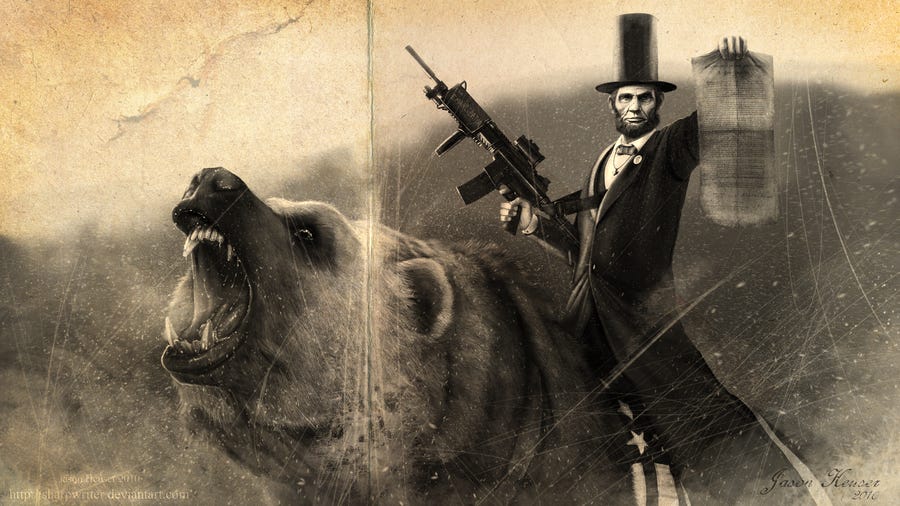
It was written by Julia Ward Howe in November, 1861. She got $4.00 for it — a sum then good for four shots of Kentucky bourbon.* It was made famous when President Lincoln, after hearing it sung for the first time, stood up, asked to hear it again, and remained standing. From there, its impact grew until it became the unofficial anthem of the Union itself. Even so, today it’s mostly used as a song for high school chorales to perform before their assembled parents. As a standard part of the American catalog, it can be found up there with “John Brown’s Body” (the melody from which it loosely borrows), “Shenandoah” and “Simple Gifts.”
But it’s something more than these are.
As anyone who’s seen “Casablanca” well knows, “La Marseillaise” makes for a better call to arms. While the French national anthem rings out for citizen soldiers to arise and “formez vos bataillons,” our fight-song is busily making wine. Not that it’s all like that, for right after the grapes of wrath are pressed and the Lord’s “terrible swift sword” is loosed, its fateful lightning is presumably there to strike secessionists in dreadful retribution. I wouldn’t want to be anywhere near Johnny Reb when that happens. So, while it isn’t fashionably French, may be weighed down by its 19th-century lyrics and would be less likely to silence a bunch of Wehrmacht officers in a North African café -- it still knows how to fight. Besides, as anyone who’s seen “Gettysburg,” or better yet — “Red Dawn” — is aware, “The Battle Hymn of the Republic” is our call to arms.
It’s right there in the name.

As a strongly Victorian work the Battle Hymn is replete with references to God. As such, it’s easy to consider it sacred. However, the song’s job is primarily to act as a nobly warring and nationalistic opus. Lit by a gentle watchfire, it evokes more of the Samuri warrior’s quiescent spirit than the embattled farmer’s rage. Perhaps this is the reason why, despite its calling upon “the hero born of woman (to) crush the serpent with his heel” (Secesh again), it’s still seen by most of us as just a baronial-sounding bit of patriotic fluff.
Despite its glorious description of an unmatched history of valor in the face of overwhelming odds, a lot of Americans view “The Star-Spangled Banner” with disdain. That’s because, well, America. For these folks, it’s “America the Beautiful” that should’ve been played every night as the TV signed off. But I call BS. Sure, “America” (its other name) deserves praise for its rare invocation of the American landscape; and while it’s admittedly more “singable,” it isn’t our national anthem any more than “Lift Every Voice” is.
Beginning when the National Football League announced that it would be played at the opening of all games during the 2020 season, “Lift Every Voice and Sing” was foisted on us as the Black National Anthem with all the subtlety of a North Korean military parade. While it’s indeed a beautiful -- and even inspirational – work that extends back to 1900, you hear Lift Every Voice less now as athletes no longer Bend Every Knee in pre-game displays of shame for the “dark past” to which the song refers. Ironically, these shows of virtue would also take place during what inference compels us to regard as the White National Anthem.
Way to unify, future bug-eaters.
Ironically too, it’s the Lift Every Voice crowd that may have put kibosh on “America.” Once the unofficial White Liberal National Anthem, “America’s” lyrics famously end up crowning the country’s “good” with “brotherhood” -- thereby coronating the latter as the supreme American value. Never mind that the Battle Hymn of the Republic calls on us to sacrifice our very lives in the war to abolish slavery, it’s “America’s” reference to brotherhood that’s earned it politically appropriate hosannas to arise from those in Malibu, on Martha’s Vineyard and in other kombucha-quaffing quarters with frontage on a shining sea. However, this reference has lately become problematic. In certain places, its elevation of brotherhood has made “America” a patriarchal Horst Wessel among Wokeism’s dying breed. Sung in violation of Code Pink’s redline, it’s become as toxic as masculinity itself for those who once would’ve knelt on Maya-Angelou-facing prayer rugs just to venerate it.

Despite also his wiping sweat from his brow with a scarf and tossing it into his Vegas crowd, Elvis nonetheless sang the Battle Hymn with a reverence that’s righteous in its reverberation. A musical phrasing of “Dixie” appears at the song’s bridge, possibly to both echo Presley’s Mississippi origins and as the Civil War Centennial’s nod to national unity (Dixie’s diasporic lyrics hadn’t yet set Leftist hair afire). Also, while giving the Battle Hymn the honor it deserves in varying degrees, other artists covering it range from Mark Twain (whose re-worded version wasn’t published until 1958 — the same year that Duane Eddy’s “Rebel Rouser” hit number 46 on the dance charts) to the Chad Mitchell Trio and Leonard Cohen. Winston Churchill was a great admirer who directed that it be played at his funeral, and Ronald Reagan was reduced to tears as the Mormon Tabernacle Choir sung it during his inauguration. Sung by the U.S. Army Band, it also marked the emotional high point of President Trump’s second inaugural.
The Battle Hymn sounded again during one of the Trump inaugural balls as the new chief, his wife Melania, and their entire family seemed made to dance to it as if it were “Begin the Beguine.” While some might rightly view its use in that context a mishandling of its solemnity, this was a joyous occasion for the president, who could be forgiven for leaning out from his wife’s embrace to exaggeratingly mouth the “Glory, Glory” lyrics on their second go-round. That’s a far cry from Reagan’s reaction, but it seemed less intended to ridicule the song than exult in The Raised Collar One’s’ funereal version of it.
Besides, that’s Trump. Jacksonian from the jump.

Now the Battle Hymn stands second only to the National Anthem in the reverence it commands. It’s not perfect, and whether or not Christ was born with any lilies nearby, it continues to stir the hearts of Americans while reminding them of their nation’s — and particularly their warfighters’ — spirit, faith, sacrifice and strength.
Besides, it’s what you carry into battle.
It says so right in the name.
*As one who can remember buying beer for 15 cents a pour in DC’s GW Inn just over a century later, I’m guessing that in 1861, dollar-per-shot whisky was a mining-camp price.